For a Webflow project, you generally have two models to choose from: a freelancer, who handles your project alone and works directly with you, or an agency, which works with a team of several specialists. Freelancers are usually faster, more direct, and more cost-effective for clearly defined projects. Agencies offer more capacity, parallel workflows, and structured project management – at a correspondingly higher price. Which model is the right fit depends primarily on the size and complexity of your project.
What is the actual difference between a freelancer and an agency?
A Webflow freelancer is an individual professional who handles your project from conception to launch themselves – design, development, and often SEO from a single source. A Webflow agency is a team of several specialists, typically with dedicated project management, that distributes design, development, and other disciplines among different people.
Interestingly, Webflow itself does not distinguish between freelancers and agencies in its Certified Partner Program – over 1,200 partners, whether individuals or teams, are vetted and certified according to the same criteria. The certificate alone doesn't tell you who you're dealing with – that is a separate decision.
When a freelancer is the right choice
A freelancer is particularly well-suited when your project is clearly defined and you have a a single, direct point of contact who manages the project from start to finish:
- New Webflow website launch with a clear scope (design, development, SEO basics)
- Migration from WordPress, Wix, or another system to Webflow
- CMS setup for blogs, projects, or other structured content
- Ongoing support – updates, minor adjustments, SEO/AEO optimization
The biggest practical advantage: there is no handing off the briefing from sales to project management to implementation. You speak directly to the person writing the code who understands the decisions you are making.
When an agency makes more sense
That doesn't mean a freelancer is always the better choice. For certain projects, an agency is actually the more suitable solution:
- Large, multi-stage rebrands with many stakeholders on the client side
- Projects that require multiple specialists simultaneously – e.g., motion design, copywriting, tracking specialists, and development in parallel
- Tight, fixed deadlines with a large scope, where multiple people must work in parallel to meet the timeline
If your project meets these criteria, an agency is often the right choice – even if that means I am not the right partner for you as a freelancer in this case.
Communication: Direct vs. multi-layered
With an agency, communication often goes through a project manager or account manager who acts as an intermediary between you and the actual implementation. It is not uncommon for your point of contact to change during a project: someone from the sales team for the initial consultation, a different team member for the implementation, and someone else entirely for follow-up questions. This has advantages—clear processes and defined responsibilities—but also a disadvantage: every time a briefing is passed on, it creates a potential source of error, and the more people involved, the greater the risk that something gets lost along the way.
With a freelancer, this hand-off is completely eliminated. The person you speak with is the same person who handles the implementation in Webflow throughout the entire project. Questions are clarified directly, without any detours.
Costs: Where the price difference really comes from
The price difference between a freelancer and an agency is usually not a question of the actual quality of the work, but of the structure behind it. An agency's hourly rate inevitably includes more than just the project work itself: project management, office infrastructure, sales, multiple salaries, and the company's profit margin. In practice, this means that for a comparable Webflow project, an agency is often significantly more expensive than a freelancer—not because the work is better, but because you are financing more overhead.
A freelancer does not carry these fixed costs to the same extent. The hourly rate primarily reflects the actual work, not the organization surrounding it.
How to recognize quality – regardless of the model
Whether you choose a freelancer or an agency, you should check the following points before starting a collaboration.
- A Webflow badge is unfortunately not a seal of quality: A certificate (Expert Exam, CMS Exam, Certified/Premium Partner) confirms that an exam has been passed—it says nothing about whether the backend is built cleanly and is maintainable. Do not rely on the badge alone.
- Always ask about the backend and the naming system: How is the CMS structured? Which class naming system is used—Client-First, Lumos, Mast, or none at all? This is exactly what determines how easily the website can be maintained and expanded later on. The most common mistakes that occur at this stageare collected in a separate article.
- Definitely take a look at an existing project: Is the work primarily done with "green" components, or is there chaos?
- Portfolio with real projects: Ask for 2–3 concrete, live websites—not just screenshots or templates.
- References you can contact directly: A reputable partner will provide references from past clients without hesitation.
Checklist: 5 questions to help you decide
- How many people need access to the project at the same time? Just you and your team → a freelancer is usually sufficient. Multiple departments with their own requirements → an agency is often more structured.
- How clearly is the project scope already defined? A clear, well-defined scope → a freelancer. An open, evolving scope with many iteration rounds → an agency.
- Do you need multiple specialized disciplines at the same time? E.g., complex motion design, copywriting, and development in parallel → an agency is likely better.
- How important is having a single, consistent point of contact? Very important → a freelancer. Less relevant, with a preference for established processes → an agency.
- How is your budget structured? A clearly calculable project budget for a defined scope → a freelancer. A larger budget spread over several months with a reserve for changes → an agency.
What this means for your Webflow project
I work as a certified Webflow Professional Partner alone and directly with my clients – without an account manager in between. This means that what you discuss in a meeting is implemented by me personally, without information getting lost along the way. For a thoughtfully built CMS, an SEO-optimized structure, or a migration from another system, this is often exactly what makes a project faster and smoother.
Specifically, my approach is as follows: I build every website using a clear framework (Lumos), document the structure in a comprehensible way, and ensure that you or a future developer can understand and maintain the website without me. This is important to me because that is exactly what sometimes falls short in freelance projects.
If, however, your project requires multiple specialists simultaneously, greater capacity, or structured project management for many stakeholders, an agency is honestly the better choice – and I would rather tell you that now than sell you a project that doesn't fit my working model.
Other great resources
If you realize after reading this article that a different setup might be a better fit for you, here are a few honest recommendations—regardless of whether they align with my own working model:
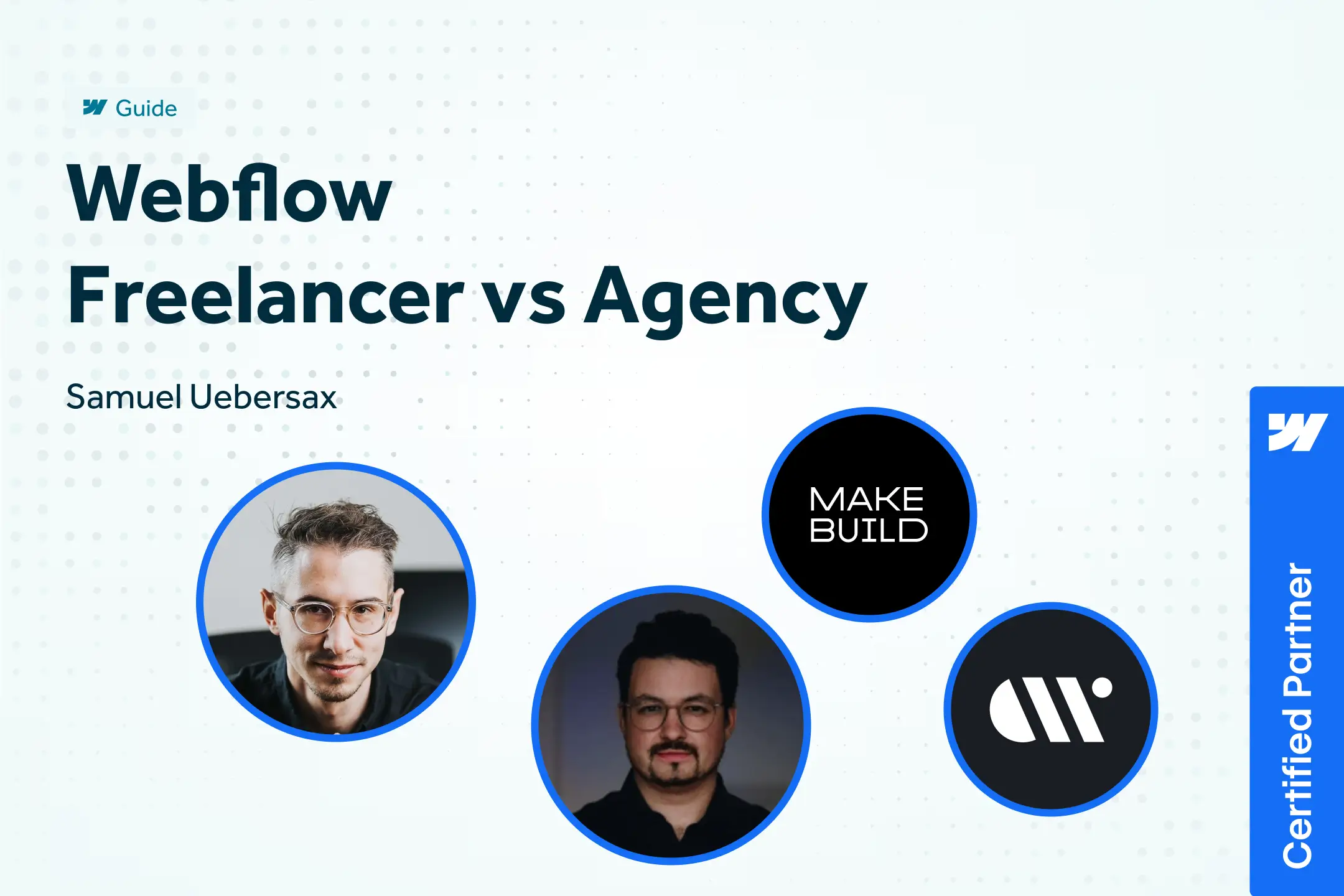
Freelancers: In addition to myself, I can Christian Schmitt recommend—a Webflow and SEO expert with a focus on performance and accessibility.
Agencies: For larger projects requiring more capacity, MakeBuild and Code & Wander are great options—both are experienced Webflow partner agencies.
Is your project a good fit for the freelancer model? Let’s discuss what makes the most sense for your Webflow website in a free initial consultation.